Cross Domain without compromise
In high-security environments, controlling and securing data flow between networks with different security domains is critical. 4Secure’s Cross Domain Solutions for Government provide trusted, efficient, and policy-enforced data transfer, ensuring the right information reaches the right place, without compromising security or compliance.
Understanding Cross Domain Solutions
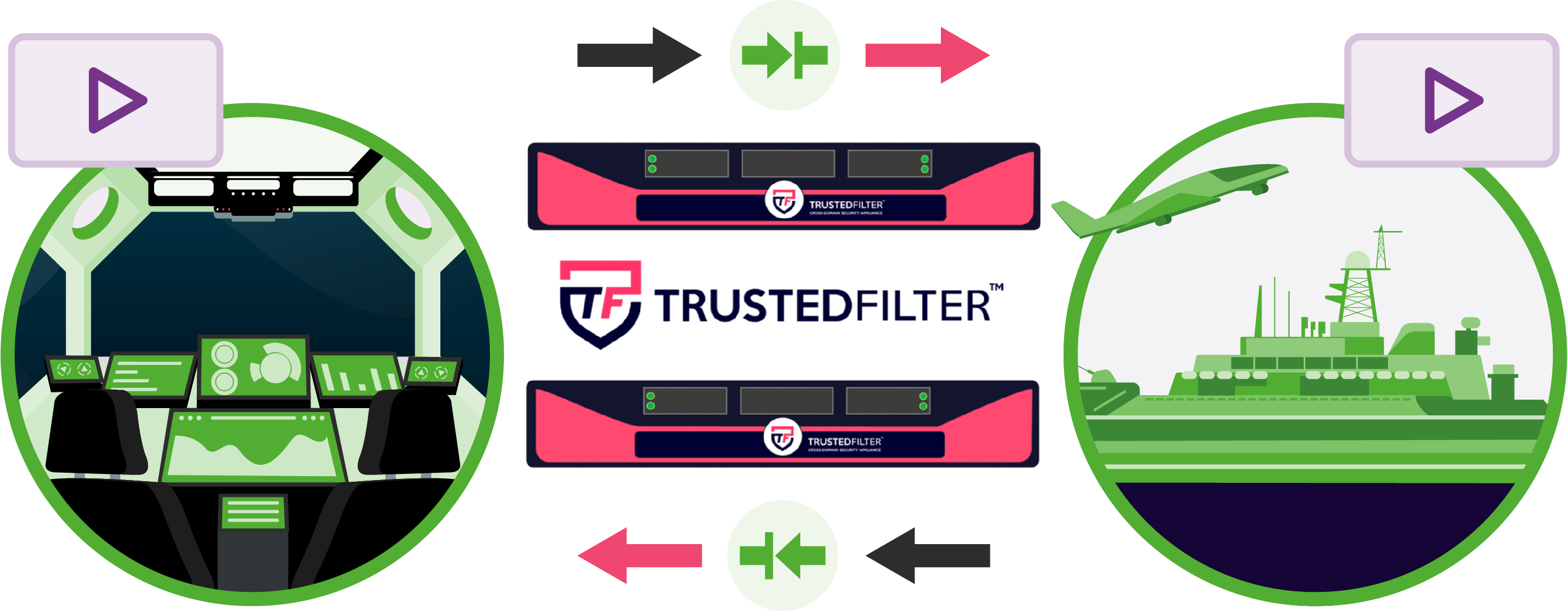
Cross Domain Solutions (CDS) enable secure data transfer between isolated environments operating at different trust levels and security classifications. By combining hardware and software architecture, they ensure controlled, policy-enforced information exchange without compromising security.
This allows organisations to maximise data intelligence and improve operational efficiency whilst maintaining strict security controls. CDS can be unidirectional or bidirectional, depending on the level of access and data flow required.
Benefits Of Cross Domain Solutions
CDS are an essential tool for organisations that require secure data access and transfer in a multi-domain environment, allowing devices of different security levels to communicate across boundaries without violating security policies or exposing sensitive data to malicious threats.

Lower total cost of ownership
Streamline your operations and cut costs by replacing time-consuming manual data import processes with CDS.
Increasing data security standards
Our solutions are designed around highly assured hardware and software to ensure compliance with the most stringent information assurance standards, including alignment with National Cyber Security Centre (NCSC) guidance.

Enchanced Collaboration
Cross Domain Solutions facilitate secure and seamless information exchange across various organisational domains, thus enabling teams to access critical data at any moment.
Software enhanced Cross Domain
At the heart of 4Secure’s Cross Domain Solutions is TrustedFilter®, a cybersecurity software suite that unlocks strategic and commercial advantage. TrustedFilter® has three core modules:

SECUREimpex
TrustedFilter®’s SECUREimpex component offers a comprehensive suite of tools designed for the secure import of data across varying security classifications. It facilitates the seamless transfer of critical images, documents, videos, software updates, and OT data between domains, ensuring adherence to stringent Information Assurance standards
SECUREcommand
SECUREstream
Supported Applications
Native applications supported by 4Secure Cross Domain Solutions and TrustedFilter® software.

Modbus Transfer

Log Forwarding

Performance Management

OPC Transfer

OSIsoft PI System Transfer

Screen Replication

Remote File Transfer

DNP3 Transfer

HTTP Transfer

Advanced Messaging Queueing Protocol

MQ Telemetry Transport
FAQs
What are the advantages of Cross Domain Solutions?
Cross Domain Solutions facilitate data sharing between two environments that would otherwise be disconnected. This offers seamless, on-demand data access for users in both environments, eliminating the need for manual import and export processes to move data between varying security classifications. Such processes are time-consuming and inefficient. Ultimately, a Cross Domain Solution enhances user productivity and boosts organisational efficiency.
What are Cross Domain Solutions?
Cross Domain solutions (CDS) combine hardware and software to securely transfer data between environments operating at different security classifications that would otherwise be disconnected. Cross Domain Solutions can be unidirectional or bidirectional.
Cross Domain Solutions serve as powerful business enablers, enhancing organisational efficiency by empowering users to have seamless on-demand access to their data, erasing the need for time-consuming manual import processes for users to get the data they need.
4Secure’s TrustedFilter® Cross Domain solutions typically include a suite of 4Secure TrustedFilter® software, which provides feature-rich capabilities while strictly adhering to information assurance principles. The TrustedFilter® software is often integrated with a data diode or other hardware-enforced unidirectional appliance.
How do Cross Domain Solutions help safeguard critical infrastructure from cyber threats?
Cross Domain Solutions protect critical infrastructure by strictly controlling data transfers between networks with different security levels. They reduce risk by enforcing one-way or tightly managed data flows, preventing unauthorised access and limiting the spread of cyber threats.
By inspecting and validating all data before it passes through, CDS ensure only trusted, policy-compliant information is transferred. This approach aligns with zero trust principles, helping organisations contain breaches and maintain the integrity of critical systems.
Can Cross Domain Solutions enable secure data transfers in zero trust environments?
Yes. Cross Domain Solutions enforce strict verification and control over all data transfers, ensuring no data is trusted by default. By combining deep content inspection with tightly governed data flows, they align with zero trust principles and enable secure, policy-compliant data exchange between environments.
What is the role of software in a Cross Domain Solution?
The crucial component of a Cross Domain Solution is its software, responsible for enabling data to flow and ensuring information assurance.
4Secure’s Cross Domain Solutions utilise 4Secure’s proprietary TrustedFilter® software to perform one of the following four key roles:
Protocol Handling: Proxies are necessary to terminate applications and protocols that usually rely on two-way communication, converting them into one-way data streams suitable for unidirectional data diodes or appliances.
Data Verification: This involves in-depth content inspection and validation to permit only the expected data for transmission.
Data Transformation: Transforming complex data types into a structured markup language is often a prerequisite to enable effective verification.
Data Decryption and Re-encryption: Decrypting encrypted traffic is often necessary for interpretation by a verification engine. If the data is successfully verified, it is re-encrypted before being sent to its destination.
Is a data diode enough?
A data diode primarily enforces unidirectional flow control through hardware.
A Cross Domain Solution combines both hardware and software to provide feature-rich capabilities. These include handling two-way protocols in a one-way environment, performing transformation on data types into structured markup languages, as well as content inspection and data validation.
Cross Domain Solutions can also be implemented for bidirectional use-cases, whereas a data diode will only function unidirectionally.