Many of today’s modern businesses are undergoing digital transformation by embracing remote work, adopting cloud computing, and incorporating Internet of Things (IoT) devices as part of their information security strategy. Such transitions need to be done securely to protect sensitive data.
But you already know that, and that’s why you’re here (smart choice). The only thing that’s got you scratching your head is “What’s the better option for cybersecurity: data diodes or firewalls?”
Both help safeguard network boundaries, but they function very differently and are designed for different purposes.
Let’s compare data diodes to firewalls in terms of data flow, common use cases, security, and compliance.
Introducing Network Security Mechanisms
Network security mechanisms are your tools, techniques, and devices that are specifically created to defend network infrastructure against attackers. This matters because data diodes and firewalls fall under this collective term, alongside encryption systems, authentication schemes, and many others.
Today’s focus is on firewalls and data diodes, and how they compare, so that’s what we’re doing next, evaluating each one separately first.
What Are Data Diodes and Why Do They Matter?
A data diode is a cybersecurity hardware device that lets information travel in only one direction from a secure network to a less secure one (or vice versa). You may have heard of it before, as it’s also referred to as a unidirectional security gateway, information diode, or optical diode.
Think about any high-security settings across critical infrastructure and enterprises such as banking, energy, or government networks. It’s clearly important that their data can be exported without getting exposed to outside threats. That’s why data diodes matter.
What Are Firewalls, and Why Do You Need Them?
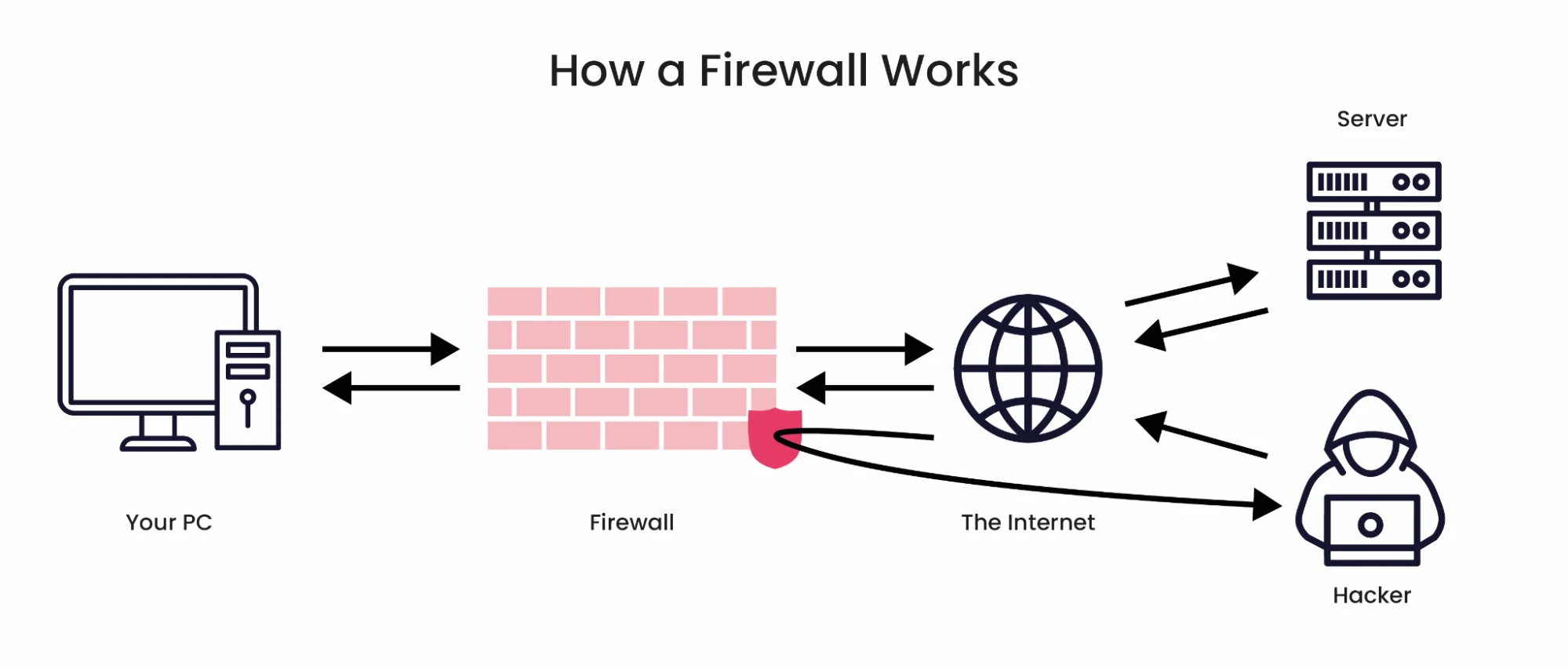
A firewall is a system that monitors and controls incoming or outgoing traffic between a trusted internal network (like your office setup) and untrusted external networks (like the internet). They come in software programs, as standalone devices, or as a hybrid of the two, called Next-Generation Firewalls (NGFWs).
See it as a “gatekeeper” that decides whether to block or accept network packets based on safety rules. Firewalls exist to protect data, block malicious content, and prevent unauthorised access to your computer.
Data Diode vs Firewall: What’s the Real Difference?
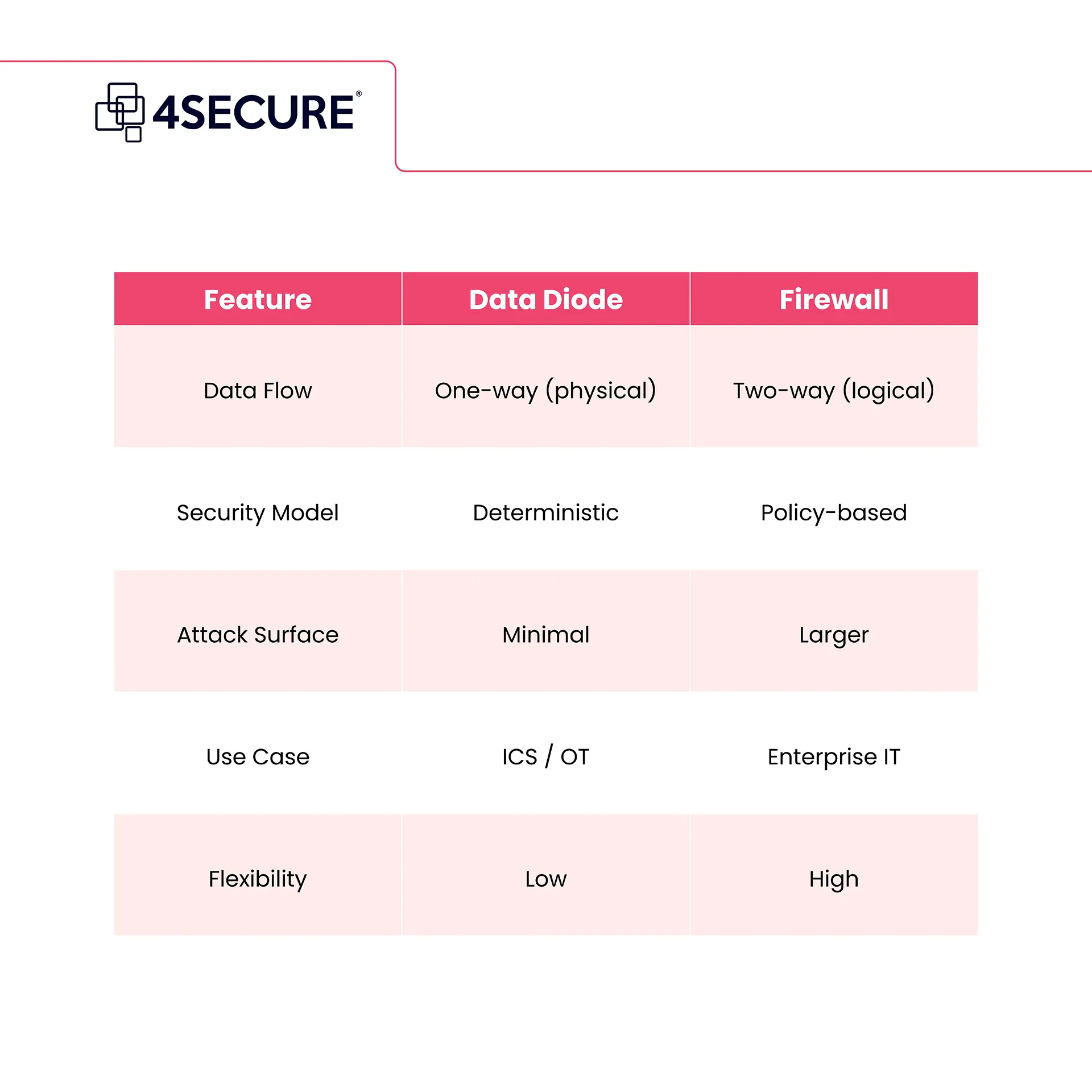
How Data Flows
A key difference between the two technologies is how they allow data to flow. We’ve already explained how a data diode enforces a strictly one-way data flow. This means there’s no physical way for data to come back the other way, and even if systems are compromised, reverse communication is impossible.
Firewalls couldn’t be more different, as they allow data to flow both ways, making them bi-directional (two-way) communication devices. Yes, data can flow in and out, but it’s still allowed or blocked based on protocols, IP addresses, and ports.
How Data Diodes and Firewalls are Used in the Real World
Data diodes protect critical OT and ICS networks from external threats like malware and ransomware. And since these networks are used across many industries, they are mainly focused on sectors that manage physical processes, automation, and infrastructure. As such, data diodes are most commonly used for video surveillance, file transfers, secure logging, industrial monitoring, and network segmentation.
Firewalls serve very different purposes. They are used to control network access by allowing or blocking traffic, protect devices against cyber threats like unauthorised access, and secure internet connections to monitor and filter traffic. Firewalls can also be used to separate various parts of networks to contain threats and limit risks, as well as enable secure connections through VPNs.
What Kind of Protection Do You Really Get?
Each one has its own set of security features that might be more beneficial than the other depending on what you need. For example, firewalls use packet filtering to check where data is coming from, where it’s going, and how it’s being sent. They also have next-generation features like:
- Sandboxing, which safely isolates suspicious files to observe their behavior before allowing them into your system.
- Deep Packet Inspection (DPI) that looks inside data as it moves through the network to catch hidden threats.
- Intrusion Prevention System (IPS), which spots suspicious activity and automatically blocks it before it can cause harm.
- Application control that identifies and manages which applications can be used, regardless of how they run.
Data diodes offer more physical protection that stops external threats at the source. By permitting data to flow in only one direction, the absence of a return path blocks malicious commands from getting in and greatly lowers the risk of malware and zero-day attacks (when hackers exploit a vulnerability that hasn’t been identified yet). The minimal attack surface of data diodes makes them more immune to software bugs, complicated configurations, and known exploitable vulnerabilities. An example of this is how firewalls are highly vulnerable to zero-day attacks when they’re not kept up-to-date, whereas data diodes are not subjected to the same update requirements since they’re hardware-based.
Another security feature that data diodes have is the ability to break protocol-level attacks. With the right software enhancement, they can break and rebuild data that passes through. Lastly, they give you the benefit of an air-gapped network without completely cutting off data flow.
How They’re Set Up in Practice
The most secure way to implement data diodes is by using fibre-optic cables where the transmit wire is connected. Only the receive wire is either absent or permanently broken on one side, making reverse communication physically impossible. In practice, however, providers will typically deploy commercially built data diodes that enforce this one-way communication at the hardware level, rather than setting up the connection manually. Data diodes often use proxy servers to handle bidirectional protocols, like TCP, over a one-way channel.
Host-based firewalls are one of the most common ways firewalls are implemented. However, solutions like 4Secure’s TrustedFilter® are not traditional host-based firewalls but are deployed on either side of the data diode to inspect, transform, and verify data moving across the one-way connection.
You also get network-based firewalls that are dedicated hardware or software positioned at network boundaries (gateways) to protect entire networks. Lastly, virtual firewalls are downloaded in virtualised environments like Azure or AWS to secure private or public cloud infrastructure.
When to Choose Data Diodes
Go with a data diode approach when you need to guarantee that information can only flow in one direction on physical hardware. This one-way air-gap is key for protecting high-security assets from cyber attacks and supporting regulatory compliance.
As such, choosing data diodes could be best if you want to:
- Secure OT/SCADA (Supervisory Control and Data Acquisition) systems to help protect critical infrastructure, such as oil and gas and manufacturing, by separating industrial control systems from corporate networks and the internet.
- Enable high-security data transfers to ensure that files such as patches and updates move in and out of networks without any risk of two-way intrusion.
- Meet regulatory compliance through strict security requirements by fully separating networks with varying levels of sensitivity.
- Block threats from risks like hacking or ransomware when firewalls alone are not effective enough, so a stronger, physical layer of protection may be needed.
- Monitor and report to allow logs and operational data to be sent out for analysis while entirely preventing any outside access back into the system.
When to Choose Firewalls
Firewalls are needed in scenarios where you need to protect networks and devices from unauthorised access, data breaches, and malicious attacks.
It’s a good idea to implement firewalls when it’s necessary to establish:
- Perimeter security to provide strong, organisation-wide protection at the edge of the network.
- Protection for individual devices that operate outside the corporate network, such as using software firewalls for remote and hybrid workers.
- Application-layer security that relies on next-gen firewalls to inspect traffic in detail, detect malware, and even control how applications are used.
- Adherence to regulations and safety in industries that need to meet strict regulations, protect critical systems, and process sensitive information.
- Traffic management to monitor and control incoming and outgoing data, which helps manage bandwidth effectively and prevent threats.
So, Which Is Better, Data Diodes or Firewalls?
Neither is universally “better” than the other, because they are in fact complementary technologies. Rather than choosing between them, organisations typically use both. Firewalls provide the flexibility needed for bidirectional communication and everyday IT operations, while data diodes deliver a deeper, hardware-enforced level of security for critical or high-risk environments.
Why Use 4Secure to Secure Your Data?
Our sovereign Cross-Domain Solutions combine hardware-enforced security (like data diodes) with intelligent software (like our TrustedFilter®) to inspect, verify, and securely transfer every piece of data without compromising operations.
We have decades of experience protecting critical infrastructure and enterprise environments, delivering tailored, high-assurance systems designed around your specific risk profile.